
By Tony Kummer
I was a children’s pastor at a small church for ten years and directed VBS ten times. I’ve reviewed hundreds of VBS kits for this site.
“We’d love to do VBS, but we’re too small. And the kits are extremely expensive.”
Small-church leaders tell us some version of that. First off, I completely understand. I directed VBS for ten years, and I know it’s not a small undertaking.
Ours was a small church. We had dedicated volunteers, and we were able to put on a big VBS because of them. I volunteered before and after those years too, and I reviewed hundreds of VBS kits for this blog.
Everything you’re saying about the difficulty is why our team wrote our own, Camp Courage VBS from The Sunday School Store. We built it to run with a handful of volunteers, in whatever setting, with whatever kids show up.
But you don’t need our VBS to use this page. There’s really no wrong way to do it.
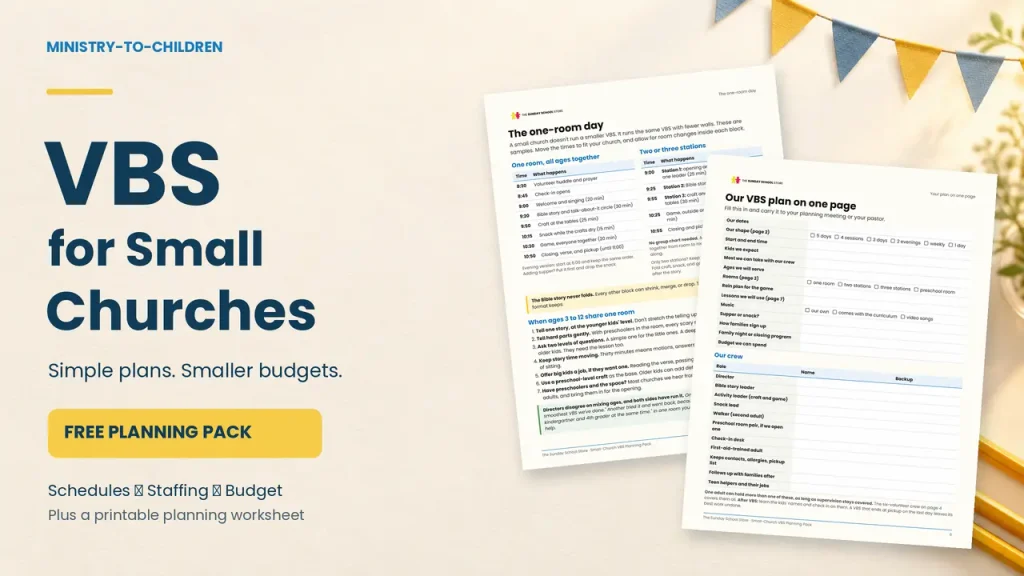
Free download: the Small-Church VBS Planning Pack (PDF, 7 pages)
No email needed. Print it and share it.
- Six VBS schedules: 5-day, 4-day, 3-day, two evenings, one night a week, one day
- A sample one-room VBS schedule, plus a three-station day
- A six-volunteer staffing chart
- What to cut when you’re short on days, time, or money, with a sample budget
- A one-page planning worksheet for your pastor or planning meeting
- Where to get lessons, songs, and videos free
What does a small church VBS really need?
Less than the kit catalogs suggest. Here is the whole goal, in order:
- Get kids in the Bible.
- Keep their attention.
- Help them have fun.
- Help them connect to the love of Jesus.
If you do those four things, you’ve run a VBS. Six kids counts. One reader told us their VBS went “from 6 students about 5 years ago to 53 last year.” I wouldn’t let any picture of what Bible school is “supposed” to be slow you down.
And if your church skips a year, you’re not alone. In our 2025 reader survey, just over half of 736 churches said they run a VBS or summer program. Almost half don’t.
6 VBS schedules for small churches
I’ll be honest. I’ve never run an alternate-format VBS myself. Ours was the classic five-day week. We tried evenings, and attendance suffered, so we went back to mornings. Our senior adult volunteers liked mornings better too. (My old night-or-day post has the pros and cons.) These six come from directors who wrote to us about what they ran, or what they plan to run next.
- Five mornings or five evenings. The classic week. Evenings work when volunteers have day jobs.
- A 4-day VBS. Monday to Thursday, or four teaching nights and a family-fun Friday. One church ran a four-lesson beach unit of ours as a 4-day VBS. Another director is planning four because “5 days could be way too much for volunteers and families to commit.”
- A 3-day VBS. Three mornings, three evenings, or a long weekend. Easier to staff than five. One church built a three-day program from lessons it already had.
- A 2-day VBS. Two evenings with dinner. The second night is family night.
- One night a week for a month. Four or five Wednesday or Sunday nights. A different church ran that same beach unit on four Wednesday nights and ended with a family fun event.
- A one-day or weekend VBS. A single Saturday, or Friday night into Saturday.
One rule for every short VBS: cut whole days. Never squeeze days. Don’t pack five days of lessons into three. Run fewer days, and give each one its full time.
Another director told us,
“Nothing fell apart, but we were wore out after a full week.” If that sounds like your team, run fewer days.
How to run a one-room VBS with mixed ages
A small church doesn’t run a smaller VBS. It runs the same VBS with fewer walls. A sample two-hour day:
- Welcome and singing (20 minutes)
- Bible story and talk-about-it circle (30 minutes)
- Craft at the tables (25 minutes)
- Snack while the crafts dry (15 minutes)
- Game, everyone together (20 minutes)
- Closing, verse, and pickup (10 minutes)
When ages 3 to 12 share the room:
- Tell one story, at the younger kids’ level. Don’t stretch the telling up.
- Tell hard parts gently. With preschoolers present, every scary moment gets its softest telling.
- Ask two levels of questions. A simple one for the little ones. A deeper “what would you do?” for the older kids. They need the lesson too.
- Keep story time moving. Thirty minutes means motions, answers, and acting it out. Not thirty minutes of sitting.
- Offer big kids a job, if they want one. Reading the verse, passing supplies, partnering with a little one.
- The Bible story never folds. Every other block can shrink, merge, or drop.
Directors disagree about mixing ages. One called mixed-age crews “the smoothest VBS we’ve done.” Another went back to age groups because it was “hard to ‘teach’ to a kindergartner and 4th grader at the same time.” In one room you don’t get to choose, and that’s fine. The steps above help.
How many volunteers does a small VBS need?
Six adults can cover a one-room VBS. Here is one example. You know your people, so change it to fit them.
- Director. Leads the opening, floats everywhere, makes the calls.
- Bible story leader. The story and the circle time, every day.
- Activity leader. Craft and game, back to back.
- Snack lead. Snack prep and the allergy list.
- Check-in desk. Sign-in, emergency contacts, and pickup at the door. A parent is a good ask.
- Walker. Moves with the kids all day. The second adult for bathrooms and hallways.
Opening a separate preschool room? Add two more. A preschool room always has two adults.
Start with your church’s own child-safety policy. It wins over anything on this page. If it doesn’t cover this, here is the idea many churches use: no volunteer is ever alone with one child. Leading a group in an open, shared room is fine. Out of sight is what to avoid, so pair up for bathrooms and hallways.
Teens are real help too. They serve beside adults, not in place of them. Give each teen a named job before the week starts.
One director told us her biggest job wasn’t finding people. It was “training up new volunteers.” A 30-minute walkthrough a week or two ahead goes a long way. Background checks are their own step, per your church’s policy.
3 ways a small church can borrow help for VBS
- A mission VBS. Our church used to run a missions VBS in another town. We would move our whole team and run the same VBS at their church a couple of weeks later. If there’s a larger or mission-minded church near you, ask. I think our local denominational office usually coordinated it.
- A community VBS. All the churches in town pool their people and resources for one full week. It works when churches cooperate well and none has enough staff or kids alone. One reader wrote, “We are having combined VBS with three churches because we all are super small.”
- Shared supplies. Ask a church that runs VBS in June if you can use their materials in July. Our church passed ours on every year. It became a tradition to count how many churches got to use our props and curriculum.
What VBS costs a small church, and where to save
One director wrote, “Kits are EXTREMELY expensive!!!” A reader here once wrote, “We collect ‘penny march’ money through the year and that is what we have to spend on VBS each summer.” You are not wrong about the cost.
- Crafts and snacks are the real base cost. Paper, glue, felt, and grocery staples can run about $2 per child per day or less.
- Printing is next. It depends on your curriculum’s page count. Print color only on pages kids will keep.
- Decorations are easy to overspend on. Borrow props. Use cardboard and butcher paper.
- Snacks can be donated. Ask church members for cookies, paper goods, and drink mix. Kids are happy with simple snacks.
- Shirts are optional. I always struggled to spend money on themed t-shirts. Our craft people had the kids make their own. For us that ran about a third of the price, and families kept them.
- Find a sponsor. One donor, one business, or a special offering can cover a small VBS.
- Buy once. A curriculum you own as a download can run again next year.
- Ask for next year’s budget the week after VBS, while everyone still remembers it.
More in my old post, How to Do Vacation Bible School on a Tiny Budget.
A sample budget: 20 kids, 3 days
- Crafts and snacks: 20 kids × 3 days × $2 = $120
- Printing: total pages you’ll print, counting every copy × cost per page
- Curriculum: $0 if you use a free program or lessons you own
- Supper, if you serve one: extra
- Reserve: about 10%
This is an example to show the math. Your numbers will be different.
VBS music for small churches
- Sing the classics you already know. One director used “some oldie goldie songs, plus one video song.” It worked.
- Build a YouTube playlist. Several directors pick songs kids will hear all year, not just at VBS.
- Use our teaching songs free. See the next list.
VBS curriculum for small churches: 4 places to get lessons
- A free VBS program. We have seven free VBS programs right here.
- Lessons you already own. Other churches have been doing this. One ran a set of Moses lessons as a three-day summer program. One turned a sports unit into a sports-theme VBS. We don’t have all the assets to fully support it, but it’s absolutely blessed. Reach out if there’s anything we can provide to make it more helpful.
- Our free songs, craft videos, and object lessons. Budget just isn’t there? Use ours. We made them for Camp Courage, and we put them on a free page so any church can use them. They work with any lessons.
- A VBS written for small churches. That’s the one I linked at the top. Its Director’s Guide has a small-church section, the six-volunteer chart, and the short-format plans. A lot of the planning pack comes from it.
There’s really no wrong way to do it. If the Lord has put it on your heart, and you have a couple of people in your church on the same page, I think you can make it happen.
About the quotes. Most come from about thirty children’s ministry leaders who answered when we asked how their VBS went, in August and September 2026. A few come from reader comments on this site. The 2025 number is from our reader survey. This is informal feedback, not a representative survey.
How does your small church run VBS?
I’d like to hear it. How many days? How many rooms? How many helpers? Leave a comment below. Your answer may help the next small church decide.
New Sunday School Curriculum: Our Bible lessons are designed to keep the kids’ attention and show how God's Word makes a difference. Every series is flexible enough for a wide-age group and affordable enough for small churches. Download a free Bible lesson in pdf or view our latest Sunday School curriculum for small churches.