

Every nursery leader knows the moment. A parent hands you a baby at the door, and the forehead feels warm. Do you take them? The short answer: if a child has had a fever, vomiting or diarrhea in the last 24 hours, they stay home this Sunday.
Use this page to write or update your church nursery’s sick child policy (some churches call it a well child or health policy), so sick kids stay home and well kids stay well. It gives you a policy you can copy, a stoplight chart for parents, kind words for sending a child home, and what to do when an illness goes around. The simplest policy mirrors your local school or daycare rules, because parents already know them.
Free: complete Sunday school lessons to try
Ready-to-print lessons from our 2027 series: four for kids ages 6–12, six for preschool ages 3–5. Read it through once and teach this Sunday. Free checkout, the download comes by email.
Teaching preschool? Get the 6 free preschool lessons.
“This topic was top of mind during COVID but is a normal part of anyone working with children. Kids get sick. And sometimes in the hurry of Sunday morning their symptoms are slow to show up until they get to the church.”
Tony Kummer, founder of Ministry-to-Children
A sample sick child policy you can copy
The headline rule: if your child has had a fever (without fever-reducing medicine), vomiting or diarrhea in the last 24 hours, please keep them home this Sunday.
Here is the full list, with when each child can come back:
- FEVER (100.4°F / 38°C or higher): Child should be fever free for 24 hours without fever-reducing medicine.
- VOMITING / DIARRHEA: Child should be episode free for 24 hours. For a known norovirus stomach bug, wait 48 hours after the last episode (volunteers too). Ordinary baby spit-up and a baby’s usual diaper pattern don’t count; new vomiting or diarrhea does. Ask the parent if you aren’t sure.
- STREP THROAT OR SCARLET FEVER: Child may return after 24 hours on antibiotics, with no fever.
- PINK EYE (red, crusty or draining eye): Child may return with a doctor’s OK, or after 24 hours of prescribed drops, once the eye is no longer draining.
- COUGH: Stay home with a cough that comes with a fever, or a hard, barking or nonstop cough. Return when the cough is easing and the child is fever free for 24 hours.
- GREEN OR YELLOW NOSE DRAINAGE: Stay home until it clears or the child is clearly getting better.
- RASH OR SKIN SORES: A rash with no known cause, or open, oozing skin sores: stay home until a doctor says they are not contagious.
- CHICKEN POX: Child may return when all spots have scabbed over. For a vaccinated child whose spots don’t scab, when no new spots have appeared for 24 hours.
- HAND, FOOT AND MOUTH DISEASE: Child may return when fever free for 24 hours and the blisters have healed.
- HEAD LICE: Child may return after the first treatment. (What to do when head lice are found in the nursery.)
- FLU, COVID OR RSV: Child may return when their symptoms have been getting better and they have been fever free for 24 hours without medicine. For the next 5 days, extra hand washing helps.
A clear runny nose, allergies and teething are fine. When in doubt, check with the nursery leader at drop-off. This policy covers every adult and teen who serves in the nursery too.
A few of these rules are stricter than the CDC and the American Academy of Pediatrics require: green or yellow nose drainage, pink eye, rashes, and waiting for hand, foot and mouth blisters to heal. That’s a fair choice for a room of babies. Just present it as your church’s rule, not a doctor’s.
The stoplight: green, yellow, red
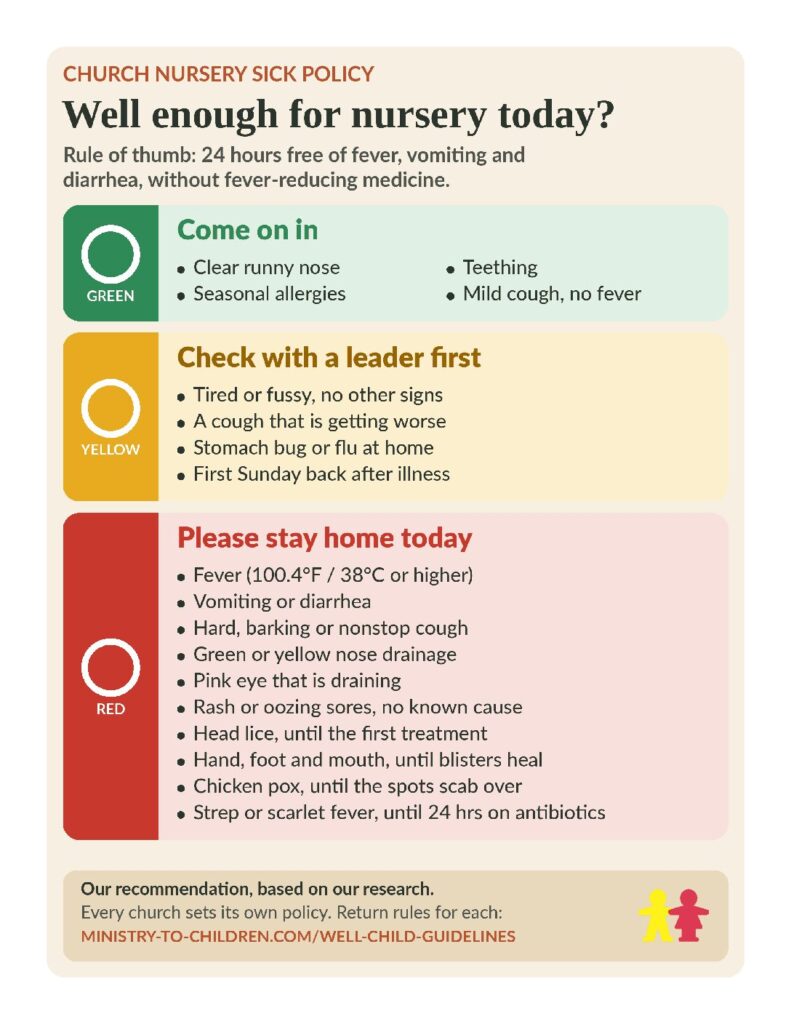
Download the stoplight to print (PDF, letter size)
Green: come on in.
- A clear runny nose
- Seasonal allergies
- Teething
- A mild cough with no fever
Yellow: check with a leader at drop-off.
- Tired or fussy, with no other signs
- A cough that is getting worse
- Someone at home has a stomach bug or the flu
- First Sunday back after an illness
The leader’s question: can this child join in comfortably, and can your volunteers care for them without leaving the other kids? If not, the child stays with the parent today.
Red: please stay home today.
- Fever
- Vomiting or diarrhea
- A hard, barking or nonstop cough
- Green or yellow nose drainage
- Pink eye
- A rash or oozing sores with no known cause
- Head lice (until the first treatment)
- Hand, foot and mouth disease (until the blisters heal)
- Chicken pox (until the spots scab over)
- Strep throat or scarlet fever (until 24 hours on antibiotics)
When each child can come back is in the policy above.
This stoplight is our recommendation, based on our research. Every church decides its own policy, so adjust it with your pastor and your leaders.
Post it all year, where parents stand still
A sick child policy can feel cold, like a sign that says keep out. Written well, it’s how we love two families at once: the parent who needs one quiet hour in worship, and the parent whose baby is in the next crib.
But a policy only works if parents see it before the morning it matters.
“In all situations it’s a balance between hospitality and protecting the other kids in the room. My policy is always let common sense and kindness set the course, but establish a sick child policy and have it posted year-round so nobody feels singled out on that stressful morning when their child is feeling unwell.”
Tony Kummer, founder of Ministry-to-Children
- At the check-in table and on the nursery door. Parents stand there every week.
- On your church website, so a parent can check at 7 a.m. on Sunday.
- In your welcome packet for new families.
- In a short reminder before flu season or when something is going around.
Keep it close to what parents already know:
“Ultimately the local school policy and daycare policies are what parents will recognize as best practices, so keep that the default.”
Tony Kummer, founder of Ministry-to-Children
In a small church
“Smaller family churches run more on relationships than policies while larger churches typically have better defined rules.”
Tony Kummer, founder of Ministry-to-Children
In a small church, a written policy protects those relationships. A written policy lets a leader explain why a friend’s child needs to go home. It also matters more when one room holds babies, toddlers and preschoolers together, because one sick child reaches everyone. Keep the policy to one page, post it, and let the same leader handle every sick-child conversation. (How to organize a church nursery in a small church.)
When a child gets sick after drop-off
Sometimes a child is fine at the door and warm by the second song.
If a child has trouble breathing or won’t respond, call 911 first, then the parent.
- Comfort the child and move them a little apart, with one adult beside them and a second adult in the room.
- Text the parent privately. No names called out in the service. For example: “Hi [name], this is [leader] in the nursery. [Child] is OK, but they [threw up / feel warm / seem unwell]. Could you come to the nursery door when you can? Thank you!”
- Meet the parent kindly at the door. Nothing they did caused this, so start there. For example: “Thanks for coming so quickly. This happens to every family. [Child] started [symptom] about [time]. Our policy asks kids to stay home 24 hours after that, so we will look forward to seeing them next week. We’ll be praying they feel better soon.”
- When it isn’t clear, go over the policy with the parent. If you’re both still unsure, the parent checks with their doctor. A church member with medical training can help if one is there.
“Have church members with medical training as part of your team or available when someone needs to make the call or take their temperature, but always with parents’ permission and in their presence.”
Tony Kummer, founder of Ministry-to-Children
- Skip routine temperature checks at the door, and don’t give medicine. Medicine stays with parents. The one exception: if a child has a written emergency allergy plan with an EpiPen, a trained adult follows that plan right away and calls 911.
- Clean what the child touched before the next service. (How to keep the church nursery clean.)
- Write it down: the date, the symptoms and which room. You will need it if you send an exposure notice.
A baby 3 months old or younger with a temperature of 100.4°F (38°C) or higher needs a call to the doctor right away. Tell the parent that plainly.
Exposure notices: who to tell and what to say
When a child in the nursery turns out to have something contagious (a stomach bug, hand, foot and mouth, strep, pink eye, lice, chicken pox or the flu), tell the families who were in that room that Sunday. Send it the same day you hear, and never name the child.
A sample exposure notice:
Dear nursery families,
A child who was in the [room name] on Sunday, [date], has since been diagnosed with [illness]. Your child may have been exposed. Please watch for [symptoms] over the next [number] days, and keep your child home if any appear, following our sick child policy. We have cleaned and disinfected the room and toys. Questions? Contact [name] at [phone].
How long to watch (time from exposure to first signs, roughly):
- Stomach bug (norovirus): 12 to 48 hours
- Flu: 1 to 4 days
- Strep throat: 2 to 5 days
- Hand, foot and mouth disease: 3 to 6 days
- Chicken pox: 10 to 21 days
Then clean the room top to bottom: toys, mats, door handles and changing tables.
If several children get the same illness, or it’s something serious, call your local health department and follow its advice on who to tell and when kids can come back.
Sick volunteers: the policy covers them too
Nursery volunteers serve out of sight, and they’re often the last to call off. Tell them plainly: staying home sick is part of caring for those babies. The same rules apply to every adult and teen in the room, because a sick helper spreads it just as fast as a sick child.
“And a volunteer with a sick child means having a backup ready so nobody tries to power through, not to let down the ministry.”
Tony Kummer, founder of Ministry-to-Children
- Name a backup for each Sunday, and keep a short text list of people who can fill in.
- Make it easy to call off. Thank the volunteer who stayed home.
- Have a plan for the empty Sunday. If no backup comes, combine rooms or ask parents to keep their kids with them in worship that day.
(Church nursery volunteer guidelines.)
When a parent blames the nursery
Some parents will be upset when you send their child home, or when their child gets sick after a Sunday.
- Let the posted policy speak. It was written ahead of time, and it applies to everyone.
- Don’t guess where an illness came from. There is usually no way to know, so don’t guess out loud, and gently stop others who do.
- Stay gentle. The nursery is free care we offer. A child who has to stay home can still join the service by recording or livestream, if you have one.
The parent’s side: “My child keeps getting sick from nursery”
Parents are not wrong to worry. Young children catch many colds a year, and every group setting shares germs. Tell them what you do: the posted policy, hand washing, cleaning toys between services, and sending sick kids home. Invite them to see the room. If they want to keep their child with them through flu season, let them know that’s fine.
The family that keeps bringing a sick child
Every nursery has one. Start with grace. The parent may not have noticed the symptoms in the rush out the door, or Sunday may be their only hour of rest all week.
- Talk privately, not at the door, and let the same leader do it each time.
- Point to the policy, not to the parent: “Our policy asks all kids to stay home 24 hours after a fever.”
- Offer help with the hard part, like the service recording or livestream, if you have one, or a meal from the church that week.
- Don’t discuss it with other parents or volunteers. If it keeps happening, ask your pastor to help.
You can’t stop every cold
No policy keeps every germ out of the nursery. Babies share everything. So do the small things well: post the policy, wash hands, clean the toys, and send sick kids home kindly. Then trust God with the rest.
The goal was never a perfect record. It’s a room where a tired parent can hand over their baby, sit down in worship and not worry. Remember that God blesses those who serve his children.
Frequently asked questions
How long should a child stay home after being sick?
Until they have been free of fever, vomiting and diarrhea for 24 hours without fever-reducing medicine (48 hours after a norovirus stomach bug). For flu, COVID or RSV, their symptoms should be getting better too.
Can a healthy brother or sister still come to nursery?
Yes, if they have no symptoms. If a stomach bug is going through the home, a quick check with the leader at drop-off is wise.
What about a child who always has a runny nose?
A clear runny nose is green, and so is teething.
What about allergies?
Seasonal allergies are green: sneezing and a clear nose with no fever. Note every food allergy at check-in, before snack time.
When can a child with head lice come back?
After the first treatment. Handle it quietly and kindly. (What to do when head lice are found in the nursery.)
Can volunteers give a child medicine?
No, except emergency medicine named in a parent’s written allergy plan (like an EpiPen). A trained adult gives it right away and calls 911. All other medication stays with parents. (Writing a church nursery manual in a small church.)
Should we take every child’s temperature at the door?
No. Watch for the signs on your stoplight, and take a temperature only with the parent’s permission and in their presence.
Looking for Bible lessons for the youngest kids? See our nursery curriculum and Bible lessons.
New Sunday School Curriculum: Our Bible lessons are designed to keep the kids’ attention and show how God's Word makes a difference. Every series is flexible enough for a wide-age group and affordable enough for small churches. Download a free Bible lesson in pdf or view our latest Sunday School curriculum for small churches.