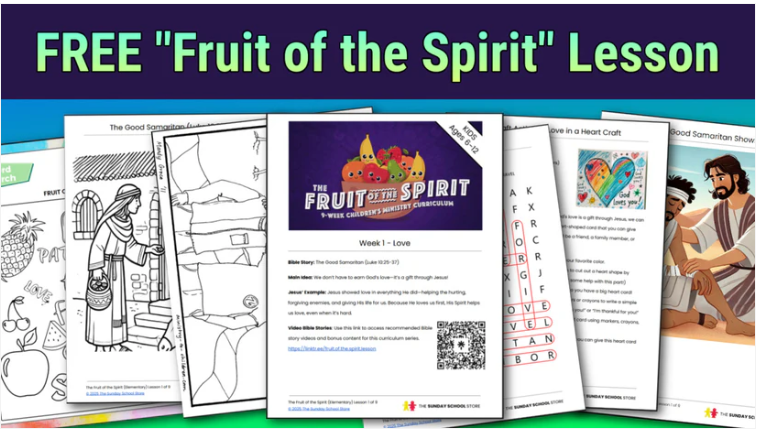

Use this Children’s Sermon message and Sunday School lesson to teach kids how “love” is a Fruit of the Spirit. We have just shared some new Bible crafts on Love to accompany this lesson pan. You may also enjoy our comprehensive 9-Week Curriculum on the Fruit of the Spirit for Kids.

Children’s Sermon – The Fruit of the Spirit is Love
Are You Fruitful? The Fruit of the Spirit Part 1: Love
Main Objective: While important, it can be confusing for kids to understand what it means to be spiritually productive as Christians. This message explains for children what the fruit of the spirit is, and how we can develop it in our lives. In particular, the focus here is on love, and how we are called to love one another, even when it isn’t easy! In doing so, we demonstrate how God loves us.
Law/Gospel Theme: It’s important to remember that we do not grow our own spiritual fruit. We cannot simply become more kind, gentle, or convince ourselves to be better Christians. The fruit of the Spirit is God working in us, through the Holy Spirit. When we are connected to Him, we will bear His fruit! As we focus on loving other people, we look to the example of Christ, who gave His life out of love for us. The bible is a love story!
Note: This is the first in a series of lessons on the fruit of the spirit. This focus this week is on introducing the concept of spiritual fruit, and describing how love is a fruit of the spirit.
Optional Materials: Fruits (preferrably real ones, but pictures or fake fruits work),
Bible Passage: Galatians 5:13-25; 1 John 4:16-21; 1 Corinthians 13
Message: Note: As with most messages, the details of how you choose to communicate this are adaptable and should cater to timing as well as to your audience and student needs.
Greet children, and show some examples of fruit…
Hello, children of God!
I have a little test for you today…don’t worry, it isn’t too hard! I am going to show you a few items, and I want to see if you can figure out what they have in common. How are these things alike? Are you ready? Let’s take a look…
Hold up several kinds of fruit. Have children identify the fruits, and then figure out that they were all fruits.
That’s right, they’re all fruits! Do you know where fruit comes from? Fruits start out as seeds. They’re planted, and grow into trees or bushes or vines. Those plants produce fruit. So an apple tree that’s doing what it’s supposed to do and being productive will grow apples. A cherry tree will grow cherries.
Now, did you know that the Bible talks about fruit? In one special passage in the book of Galatians, it talks about something called the fruit of the Spirit. The fruit of the Spirit isn’t something that you eat, though. It’s something that we demonstrate in the way that we live our lives as Christians. A good fruit tree will have fruit growing off of it. The “fruit” we have is the evidence that God’s Holy Spirit lives inside of us. When we know Jesus, and when we are close to the Lord, the Holy Spirit is part of who we are. Others will be able to see that by how we act and treat people. The fruit of the spirit is described as love, joy, peace, patience, kindness, goodness, faithfulness, gentleness, and self-control. We will talk about what each of those things means, but first, why don’t we focus on Love?
FREE 4-Week Sunday School Sample Pack
Four complete print-and-teach PDF lessons for ages 6–12 — from the new 2026–27 curriculum.
Download Free PDF LessonsPlanning the whole year? See the Back to School 52-Week Bundle
Love should be the most important part of who we are and what others see in us. The whole Bible is God’s story of love for us. He loves us so much that He was willing to become a human and even die for us. The Bible says this is the greatest love someone can have, to give their life for someone else. God’s Word also tells us that God is love, and if we love God, we ought to love others, as well. “We love because He first loved us.” (1 John 4:19) When we show love to others, it is a way of demonstrating the love God has for us. We can offer kind words, smiles, or helpful actions to other people. We can show them respect for who they are. This isn’t always easy! Sometimes we have to love people, even if we don’t always feel like it, or even if they aren’t always nice to us. That can be extra challenging. But we know that every person is made by God, in His image, and loved by Him. Sometimes that helps us show His love. The other great thing we can do is pray! We can ask for God’s help to love and care for people, and to know how best to show them God’s love.
Why don’t we say a prayer now, and ask God to help us love others and be “fruitful” as Christians?
Prayer:
(Have kids repeat each line)
Dear God,
Thank you for the gifts of your Spirit
Help us to share those gifts with others
And to demonstrate to them the love you provide.
Help us to read and understand your word.
Thank you for your love
We love you, God!
In Jesus name, Amen!
Bible Verses/story to Reference:
For you were called to freedom, brothers. Only do not use your freedom as an opportunity for the flesh, but through love serve one another. For the whole law is fulfilled in one word: “You shall love your neighbor as yourself.” But if you bite and devour one another, watch out that you are not consumed by one another. But I say, walk by the Spirit, and you will not gratify the desires of the flesh. For the desires of the flesh are against the Spirit, and the desires of the Spirit are against the flesh, for these are opposed to each other, to keep you from doing the things you want to do. But if you are led by the Spirit, you are not under the law. Now the works of the flesh are evident: sexual immorality, impurity, sensuality, idolatry, sorcery, enmity, strife, jealousy, fits of anger, rivalries, dissensions, divisions, envy, drunkenness, orgies, and things like these. I warn you, as I warned you before, that those who do such things will not inherit the kingdom of God. But the fruit of the Spirit is love, joy, peace, patience, kindness, goodness, faithfulness, gentleness, self-control; against such things there is no law. And those who belong to Christ Jesus have crucified the flesh with its passions and desires.
If we live by the Spirit, let us also keep in step with the Spirit. -Galatians 5:13-25
Children’s Sunday School Lesson – The Fruit of the Spirit is Love
The Fruit of the Spirit is an important topic to discuss with children, although it can be a little confusing to understand what it means to bear God’s fruit. We don’t produce the qualities that Galatians list as “fruitful” on our own, but through the power of God’s spirit. This is the first lesson in a nine-week series on the Fruit of the Spirit, and emphasizes the element of love.
Lesson focus: In this lesson, students will consider the Fruit of the Spirit, and what it means to demonstrate God’s love and care to those around us. If desired, this lesson could be separated into two parts, with one focusing on an introduction and the second on love.
Passage: Galatians 5:13-25; 1 John 4:16-21
Target Audience: Elementary School, adaptable for K-6th Grades
Materials Needed: Construction paper, decorative materials, paper plates, fruits, blindfolds, scissors, Bible (all optional, depending which activities you choose to use—except for the Bible, you need that for sure).
Lesson Opening: This lesson describes the Fruit of the Spirit and how God bears His fruit in our lives. It also hones in on love and how we share God’s love with others. To introduce the topic, consider some fun fruit-related activities for children. Some of these suggestions can be done throughout or at the end of the lesson, as well as near the beginning.
Here are some activities to get kids thinking…(select the best ones for your audience and age group):
- “Fruit Basket Upset” game: this is a classic spin on musical chairs, and works best for larger groups. Give students a fruit (have a couple of oranges, a pair of pears, maybe three or four apples, etc.) and have everyone sit in a circle. Invite an announcer to stand in the center of the circle and call one or two fruits. All of those students will stand and switch spots, attempting to secure a new seat. Whoever does not have a chair will serve as the next caller. If the caller announces “fruit basket upset”, all students will switch spots.
- Fruit Pictionary: Have students draw a fruit on a white board or large paper, and invite others to guess what the fruit is.
- Fruit taste test: Blindfold students and invite them to sample different fruits and distinguish what they are (be sure to check for allergies ahead of time).
- Fruit poll: Create a graph of which fruits students enjoy the most.
- Planting seeds: look at pictures of seeds or actual plants that produce fruits (and other things), and identify what type of produce the seeds will grow into when planted and taken care of. Discuss what is needed for plants to grow.
- Balloon race: give each student a balloon, and gather in two lines. Have students race two at a time across a playing area, blowing up the balloon, releasing it, and running to the spot it lands. Continue until the balloon reaches the end of the designated area, and then run back to tag the next player, relay-style. Explain that God’s love fills us (like the balloon) so that we can go and love others!
Explain that today’s topic is a first look at the fruit of the Spirit. The fruit of the Spirit is not something you would eat or plant in the ground, however. Spiritual fruit refers to how we display evidence that God is at work in our lives. When we are connected to Him, others will be able to tell through our characteristics and love.
Ask: What does it mean to be spiritually healthy? Have you ever heard someone refer to a person’s life as “bearing fruit”?
Bible Lesson: As always, how you choose to experience the passages will vary according to the ages and abilities of your children (and how many are participating). This passage contrasts the wicked characteristics of self-centered living with the beauty of Spiritual Fruit. Allow older students to take turns reading verses. For younger students, be sure to pause to discuss what some of the terms mean and why they are significant. You might even want to have kids mime or give facial expressions for what some of these would look like.
Note: this passage can be abbreviated if you prefer to focus on the love element in 1 John.
You, my brothers and sisters, were called to be free. But do not use your freedom to indulge the flesh; rather, serve one another humbly in love. For the entire law is fulfilled in keeping this one command: “Love your neighbor as yourself.” If you bite and devour each other, watch out or you will be destroyed by each other. So I say, walk by the Spirit, and you will not gratify the desires of the flesh. For the flesh desires what is contrary to the Spirit, and the Spirit what is contrary to the flesh. They are in conflict with each other, so that you are not to do whatever you want. But if you are led by the Spirit, you are not under the law. -Galatians 5:13-18
For younger students, it might be difficult to explain what is meant here by “indulging in the flesh”, and you may wish to not go into great detail on that point. Focus on the importance of loving God and loving others. Describe how being in the “flesh” refers to the sinful behaviors we might fall into, and the bad things that we do. Walking by the Spirit means trusting God and being connected to Him, like a root is connected to a tree for all nourishment.
Ask: What are some of the bad things that we sometimes do?
The acts of the flesh are obvious: sexual immorality, impurity and debauchery; idolatry and witchcraft; hatred, discord, jealousy, fits of rage, selfish ambition, dissensions, factions and envy; drunkenness, orgies, and the like. I warn you, as I did before, that those who live like this will not inherit the kingdom of God. -Galatians 5:19-21
Again, younger students might not need to delve into the specifics of drunken orgies. In fact, for especially little ones you might alter wording entirely. Put these things into “kid terms” by discussing some of the things that they do when they make mistakes or disobey. What are things that they might want to do when they shouldn’t?
You could also connect this to the fruit element by describing how it might sound fun to eat ice cream and cookies for every meal, but we know that healthy bodies need nutritious foods like fruits and vegetables. In the same way, our Spiritual lives need healthy things going into them in order to let God work through us and produce His fruit.
Ask: Have you heard of the fruit of the Spirit? What are some good things you can think of that would show a person loves God?
But the fruit of the Spirit is love, joy, peace, forbearance, kindness, goodness, faithfulness, gentleness and self-control. Against such things there is no law. Those who belong to Christ Jesus have crucified the flesh with its passions and desires. Since we live by the Spirit, let us keep in step with the Spirit. Let us not become conceited, provoking and envying each other. -Galatians 5:22-25
Walk briefly through each of these terms to make sure students have a firm grasp on their meaning. Invite children to explain the terms and provide examples of them, to gauge understanding. Explain that we will be going through each term closely, beginning with love.
Ask: Which one of these things do you think you can improve on?
Ask God to help you work on that “fruit” more throughout the week.
Note: If time allows (especially if you are making a separate introductory lesson and love lesson), you might begin earlier in 1 John 4, and cover more verses. You may also consider including a look at 1 Corinthians 13, the classic passage on love.
So we have come to know and to believe the love that God has for us. God is love, and whoever abides in love abides in God, and God abides in him. By this is love perfected with us, so that we may have confidence for the day of judgment, because as he is so also are we in this world. There is no fear in love, but perfect love casts out fear. For fear has to do with punishment, and whoever fears has not been perfected in love. We love because he first loved us. If anyone says, “I love God,” and hates his brother, he is a liar; for he who does not love his brother whom he has seen cannot love God whom he has not seen. And this commandment we have from him: whoever loves God must also love his brother. -1 John 4:16-21
Emphasize to students that God commands us to love Him, and to love others. By showing His love to one another, we demonstrate that we love and are devoted to God. When we are close to Him and remember how much He loves all of us, we should want to care for those around us. Of course, it isn’t always easy! But God can help us to act out His love.
Ask: When is it hard to show others God’s love? How can we demonstrate it?
Provide various scenarios and have students identify ways to love others accordingly (for example, if someone was sad about the loss of a pet, if someone felt lonely, if someone needed help with homework, if your mom asked you to do the dishes, etc.).
Close with a prayer thanking God for bearing fruit in our lives. Ask for His help in staying connected and close to Him, so that we can continue to demonstrate His “fruit” and show His love to one another.
New Sunday School Curriculum: Our Bible lessons are designed to keep the kids’ attention and show how God's Word makes a difference. Every series is flexible enough for a wide-age group and affordable enough for small churches. Download a free Bible lesson in pdf or view our latest Sunday School curriculum for small churches.